
About ObsessChess
The Forensic School of Analysis
A novel approach that begins by identifying the pieces that participated in a successful mating pattern, and then charting those pieces' movement and interactions from the opening theory through the midgame strategy to the final attack. The purpose of this method is to enhance our understanding of the game by bridging concepts that have historically been compartmentalized.
ObsessChess asks the question:
What role did these pieces play at each stage of the game in the process of reaching the final boardstate?
Welcome to ObsessChess!
Join me each week to explore the wide world of Chess. This centuries old game fascinates our species. It is an infinite wellspring of curiosity, mystery, and intrigue. Masters report being able to look a flat surface and see pieces moving across a checkered board. We are drawn to the boundless interplay between balanced forces, the incremental accumulation of complexity, and the artful combinations of inspired savants, the brilliant matches passed down to us by masters who are now only ghosts, the relationship between order and disorder, between causality and chaos, the burning elusivity that captivates generals and poets alike. It is the great equalizer of an age. Chess disregards wealth, power, status, creed, and dogma. It rewards curiosity, patience, imagination, presence of mind, and the power of will. It is an inherently honest game; it makes no attempt to conceal its secrets from the player. Everything you need to know about the game is right there on the table. The pieces, their positions, their potential- all observable, measurable, and quantifiable. And yet within sixty-four squares, thirty two opposing pieces propose a staggering universe of unique possibilities.
Over the last two hundred years, our predecessors have sought to discover and derive emergent systems. In the Romantic Era, dominant players attacked aggressively and sacrificed pieces at will to mate the king. The industrial revolutions nurtured new ideas about empiricism and mechanical systems, heralding scientific thinkers who valued positionality and structure. This paradigm produced a generation of counter-revolutionary thought aimed at dissassmbling institutions and exposing their vulnerabilities. It was the Soviet School who then devoted themselves to the organization, classification, and exploitation of competitive advantage. They did not proceed from dogma, nor arrive at it. They won by mastering the space in between, by applying a century of insight gleaned from all of the opposing points of view, and by understanding when to apply them, and why. In a sense, this was not just the end of the age of analog chess, but the natural product of it. Nature preceded science, which yielded philosophy, which yielded advantage. We saw in Morphy the wild man with a supernatural gift. We saw in Steinitz the scientist recording observations and trying to demystify the knowable world. In Capablanca, we witnessed the reactionary demonstrating the supremacy of instinct and confidence over postulates and theories. In Tal, the world watched as a wizard command his pieces as if he was conducting a symphony.
After Karpov, the last great champion of the last great era of chess, a new player entered the game: the Machine. The Machine's influence on the game of chess can never be sufficiently quantified, nor can it ever be overstated. Where the Soviet era of players looked back upon a century of accumulated wisdom in the form of discussion, debate, and dialectic, the machine promised irrefutable proofs and unfalsifiable refutations. Openings became Engine Lines. Theories became Variations. Study, while never completely vulnerable to obliviation, nevertheless was supplanted by Rote Memorization. Players have seen this inevitability coming for decades, and have expressed a full spectrum of opinions about the implications on competitive play, but the reality is that most of the chess enthusiasts in the world have little interest (but never zero, of course) in chasing their way across the chess championship circuit. Most of us have even less chance of ever being able to defeat players that can recall forty moves for thirty variations for twenty openings, but that doesn't stop any of us from loving the game and wanting to learn its secrets.
ObsessChess is a destination for anyone looking for a new perspective on an old subject. Historically, analysis in this field has been inherently linear, because games are naturally played and studied from beginning to end. Here, we will treat the outcome, the mating position, as the starting point of the discussion. A novel approach that begins by identifying the pieces that participated in a successful mating pattern, and then charting those pieces' movement and interactions from the opening theory through the midgame strategy to the final attack. The purpose of this method is to enhance our understanding of the game by bridging concepts that have historically been compartmentalized. ObsessChess asks the question: What role did these pieces play at each stage of the game in the process of reaching the final boardstate? In a way, this mode treats each individual piece as a unique character with its own agency, motivation, limitation, and destiny. The natural course of the game evolves around the prerogatives of these pieces. What sacrifices were necessary for their advance? What spaces did they sieze, occupy, and defend? What threats to the pose or prevent? What does the contest look like through the eyes of the humble pawn, the brave rook, the wild knight, the cunning bishop, or the roving queen? Does relating to the pieces as individual characters help us to better understand the story?
Over the coming seasons, we will go back to the beginning and try to see old things with new eyes. Each week, we will revisit the famous games of legendary players. We will explore openings, strategies, tactics, and theory, and trace our way through the procession of ideas and attitudes that rose and fell over the years. We will learn and grow together as a community of captive hearts and inquisitive minds. We will try to connect the opening theories with the midgame pawn swarms, asymmetrical exchange sacrifices, and material advances, to better understand the how, where, when, and why, of the final checkmate. We will also examine club games, fan submissions, and the contemporary competitve scene, and we will try to apply these lessons and principles in live matches against real players in real time.
Episode Schedule
The Romantic Era & The Lone Assassins
Exploring the 18th and 19th centuries, where rapid development, open lines, and wild king hunts created crystalline mating networks.
- Weeks 1-2 (Episodes 1-2): François-André Danican Philidor — Uncovering the hidden mechanics of pioneering pawn structures.
- Weeks 3-4 (Episodes 3-4): Adolf Anderssen — Dismantling the tactical architecture behind the Immortal and Evergreen masterpieces.
- Weeks 5-6 (Episodes 5-6): Paul Morphy — Tracing the relentless efficiency and geometric beauty of America's first prodigy.
- Week 7 (Episode 7): Mikhail Chigorin — Examining the fierce, creative counter-attacks that birthed the Russian school.
The Classical Era & The Invisible Outposts
The dawn of positional order. Tracking how the ultimate mating net is the logical result of an anchor piece placed 20 moves prior.
- Weeks 8-9 (Episodes 8-9): Wilhelm Steinitz — Reverse-engineering the foundational laws of accumulation of small advantages.
- Week 10 (Episode 10): Siegbert Tarrasch — Tracing the strict, logical geometry of center control and space.
- Weeks 11-12 (Episodes 11-12): Emanuel Lasker — Forensic profiles of psychological chess and defensive resilience.
- Week 13 (Episode 13): Harry Pillsbury — Deconstructing the lethal, long-term trajectory of the classic Queenside minority attack.
The Hypermodern Revolution & The Long-Range Snipers
Breaking classical rules. Investigating flank openings and hidden bishops that strike from afar after lurking on their starting squares.
- Weeks 14-15 (Episodes 14-15): Aron Nimzowitsch — Tracking the deep, restrictive paths of overprotection and blockades.
- Week 16 (Episode 16): Richard Réti — Deconstructing the dynamic retreat and the power of the flank invitation.
- Weeks 17-18 (Episodes 17-18): Alexander Alekhine — Following hyper-aggressive, complex combinations back to their quiet origins.
The Soviet Hegemony & The Dynamic Era
Unprecedented scientific rigor and chaotic mid-game brawls. Tracing the golden thread of a mating idea through pure calculation.
- Weeks 19-20 (Episodes 19-20): The Hegemony (Botvinnik, Smyslov, Petrosian) — Forensic breakdowns of deep positional iron curtains.
- Week 21 (Episode 21): Mikhail Tal — The ultimate romantic in a modern era. Tracking pieces through a beautiful, chaotic fog of war.
The Engine Era & Modern Cybernetics
The rise of silicon titans. Reversing the cold, concrete, computer-validated novelties that redefined human understanding of harmony.
- Weeks 22-23 (Episodes 22-23): Garry Kasparov vs. Deep Blue — Forensic analysis of the historic paradigm shift between human intuition and machine calculation.
- Weeks 24-25 (Episodes 24-25): The Centaur Era (Anand & Carlsen) — Tracking the flawless endgame conversions of players who came of age studying with silicon assistance.
- Weeks 26-27 (Episodes 26-27): Neural Networks & Beyond (Stockfish & AlphaZero) — Reversing the bizarre, hyper-fluid piece sacrifices of modern AI engines to find the hidden logic beneath the code.
News
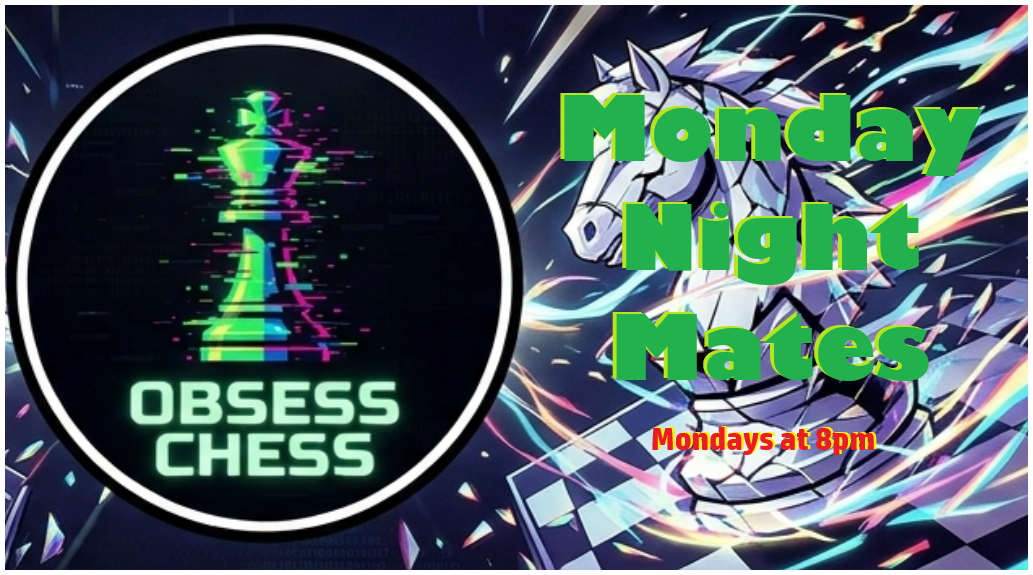
ObsessChess will begin streaming on Monday, November 2nd, 2026, at 8pm CST.
The weekly show format will feature news about what's happening in the wide world of chess, discussions of openings, players, and games, as well as reviews of club matches and audience submissions, and live play on Lichess. My goal is to learn more about this mysterious and fascinating game, and to make new friends in the Chess community as I go.
Want to play a match with me during the show? If you've got a valid Lichess account in good standing, just give me a shout in the chat! I am relatively new to the game, and I built this channel as a way to chart my development over time, and as a creative outlet for preparing and presenting research on the multitudes of subjects I encounter while studying, practicing, and exploring. If you're a new player, welcome aboard! We can learn together. If you're a more advanced player, I welcome your insight and perspective. What would you do in a given position? Why do you prefer one system to another in a given circumstance? Who are your favorite players? I want to provide a friendly, humourous, thoughtful atmosphere, where players of all disciplines can find kinship and common ground.
Your lives matter and you have value! Thanks for watching!
Upcoming Events
Monday Night Mates! will stream its first episode on Monday, November 2nd, at 8pm CST.
As I get the channel going and get some momentum, I will begin developing show plans and scheduling them here. Watch this space!
Contact
Your participation matters!
Would you like to challenge me to a game? Is there a topic you want me to cover in a livestream? Did you see a massive blunder in a match? Tell me all your hopes and dreams, and become a part of the ObsessChess community!
Send me a message at ObsessChess@gmail.com!
You may also join the ObsessChess Discord!
Support
Click this link to support ObsessChess on Patreon!
For the price of a cup of coffee, you can help this channel grow! A small monthly sub gets you exclusive access to the ObsessChess Discord community. Membership benefits will be added as this project develops, but right now, just getting off of the ground is a huge step! Get in at the ground floor and grow with me!